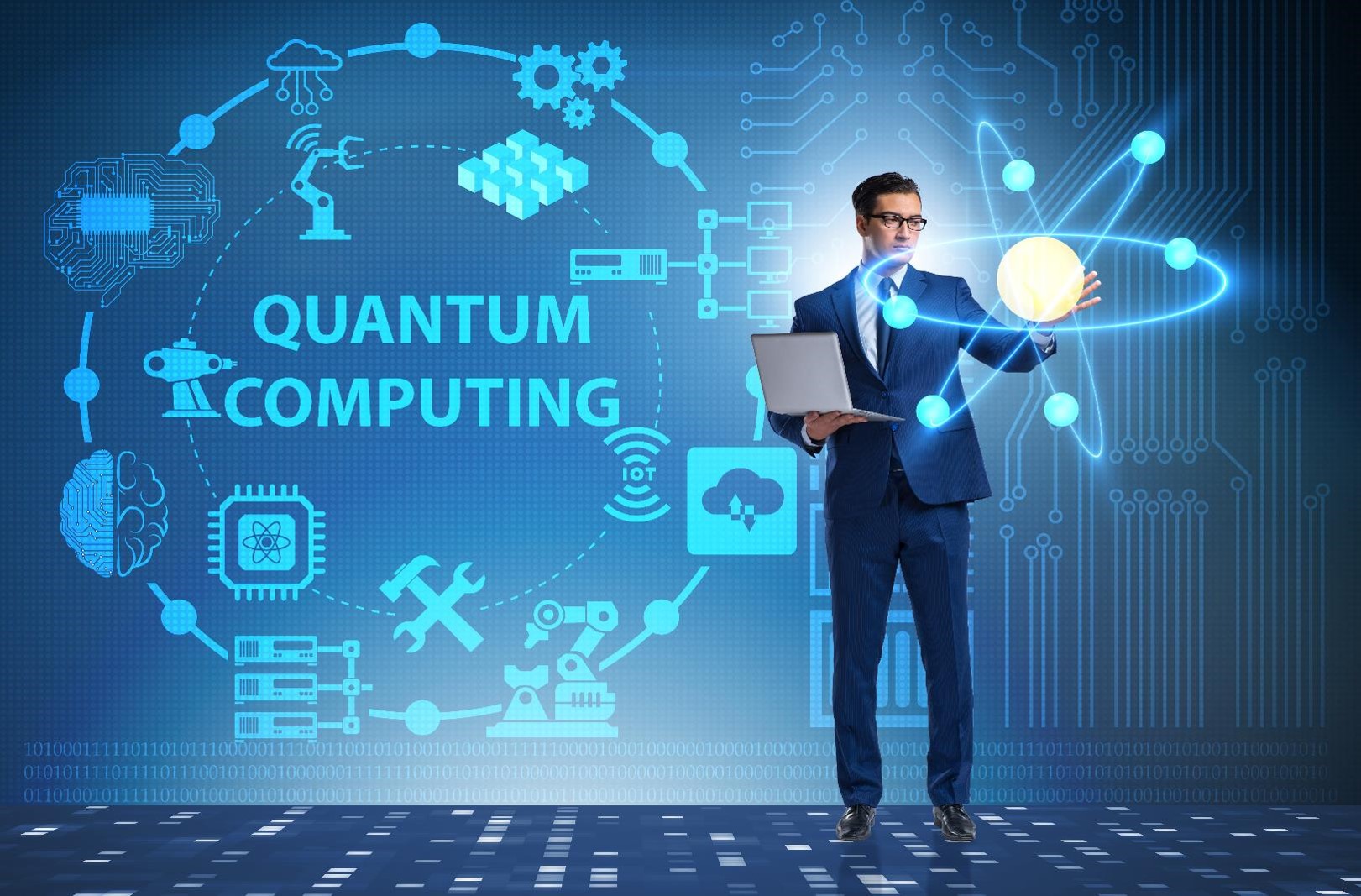
Quantum computing, like Artificial Intelligence, has seen significant advances in its capabilities and reliability in recent years. Quantum computing applies principles of quantum mechanics to solve complex computing problems faster than traditional computers. Unlike traditional computers that use binary bits (0s and 1s), quantum computers use quantum bits or “qbits,” which can exist in multiple states simultaneously.
Through superposition, qbits can represent both 0 and 1 simultaneously. Increasing the number of qbits that are entangled (i.e., correlated) with each other exponentially increases the number of possible simultaneous computations. By manipulating interference patterns of entangled qubits in superposition, quantum computers can quickly parse potential solutions and converge on the correct answer. This enables the massive storage and parallel processing of information, as well as probabilistic computations that make it possible to provide a range of potential solutions to certain types of problems.
Although current quantum computers are largely in the experimental stage, they hold promising potential to generate advances in a variety of fields by solving problems that are currently very difficult or impossible for traditional computers. Anticipated applications for quantum computing technology include advancing the capabilities of machine learning and artificial intelligence; optimization problems in finance and logistics; simulation of complex chemical and physical systems, including semiconductor chips; and unbreakable cryptography and secure communications to defeat hackers.
Given the complexity and rapid pace of innovations in quantum computing, NSIP Law is uniquely positioned to recognize not only the technical operation of their client’s quantum computing inventions, but to also understand and appreciate their implications for other technologies and fields of endeavor. Recent innovations in quantum computing have included the discovery of a new state of matter, known as a “topological superconductor,” which may significantly advance quantum computing capabilities.
Other innovations have involved advances in quantum processor chip manufacturing methods and accompanying improved quantum chip designs; algorithms for processing quantum data, such as those involving quantum and machine learning integration; advances in hybrid quantum-traditional algorithms; improved semiconductor materials; improved quantum optimization techniques. Advances in methods for interference reduction and error correction capabilities through, for example, the development and implementation of abstract logical qbits have also been achieved.
NSIP Law’s patent attorneys regularly work with major international corporations and research institutions to protect their quantum computing inventions in the following fields:
Quantum logical qubits chips, and their operations, structures and arrangements.
Resonators for qubits and resonance frequency controls
Superconducting qubits
Rabi frequency detection
Qubit couplers with resonant frequency control
Qubit crosstalk and slot reduction methods
Quantum-dot qubit devices and methods of manufacture
Quantum interconnections, including transmission lines, couplings, antennas, and waveguides
Quantum error mitigation algorithms
Please contact our Managing Partner, Charles Y. Park, at Charles@nsiplaw.com in order to discuss how NSIP Law may assist you with the protection of your quantum computing inventions.
Design patents are granted for a new and nonobvious design for an article of manufacture, the ornamentation applied to an article of manufacture, or both. Unlike utility patents, which protect the structure, function, chemical composition, technology or method of use of an invention, design patents protect the ornamental visual appearance of a product. Design patents thus provide a critical, yet often overlooked method of protecting your products from copying. This is particularly true in industries where the shape, configuration, appearance and color of a product, and its ornamentation, are of critical importance to brand recognition among consumers throughout the world.
Design patents protect traditional manufactured products of an almost infinite variety. In the digital age, the law of design patents has evolved so that now the visual appearance of graphical user interfaces and icons displayed on computer monitors and mobile devices are eligible for design patent protection as well. Laws protecting digital designs are currently evolving to include protection for digital images of virtual products or spaces, such as those employed by video games, or virtual or enhanced reality displays, whether they are static or in motion. This has provided high technology companies and software developers alike with the ability to carve out exclusive property rights for their creativity on a wide landscape, and to compete globally based on the unique look and feel of their interfaces or graphical renderings.
NSIP Law has developed an experienced and knowledgeable group of attorneys and paralegals who focus their practice on the procurement of design patents for our clients. NSIP Law’s design patent practice has consistently ranked among the largest of such practices in the United States. As a result, NSIP attorneys are in the enviable position of being able to assist clients with a comprehensive strategy for protecting and enforcing their design patent rights throughout the world. Our expertise extends to the following matters:
Counseling regarding the eligibility of products, or individual product features, for design
patent protection.
Counseling regarding the relative risks and benefits of using black & white line drawings, color or color contrast as part of drawings, grayscale/CAD drawings, or photographs to express the design elements.
Strategies for protecting entire designs, partial designs or design components that may be critical to the client’s competitive advantage in the marketplace.
Strategies for filing multiple applications that claim various aspects of a unified design, in order to defeat counterfeiters or infringers who make slight changes to a product to avoid infringement.
Strategies for claiming graphical user interfaces and icons, both as static displays and as transitional or animated graphical user interfaces whose images change in a sequence.
Coordinating the preparation of formal design drawings for design patent applications filed in the United States and abroad.
Drafting design patent applications and prosecuting them before the U.S. Patent and Trademark Office.
Strategies for protecting design patent rights internationally.
Trademark Practice
A company’s brand name and logo represent the reputation on which they succeed in the global marketplace. Trademarks, service marks, trade names and trade dress are clear examples of how a company’s intellectual property portfolio impacts everyday business, the value of its brands, and the image and relationship that it has with its customers and suppliers. These distinctive and valuable marks can take the form of words, both real and fanciful, as well as logo designs and even distinctive ornamental product configurations and shapes. Distinctive sounds and color schemes that uniquely identify well-known brands have also been protected as trademarks. NSIP Law understands that a company’s brand, and all of the components that go into it, is a critical component in their continued success, as they build on their past and current accomplishments, and strengthen and expand their relationships and establishments globally.
Our intellectual property attorneys are skilled in obtaining secure and enforceable trademark and service mark registrations, policing those trademark rights against infringements by third parties, and providing consultation and opinions in trademark and trade dress enforcement matters. We have successfully filed and prosecuted trademark applications for many different types of clients in a variety of industries, and have the experience and knowledge to protect your name, brands, logo designs, trade dress and product configurations both domestically and internationally.
We specialize in the following areas:
Assisting clients with the selection of distinctive word, design and product configuration trademarks that would most easily qualify for registration and provide them with strong and enforceable rights.
Global registrability and clearance searches and investigations to determine the availability of marks for use, and the eligibility of marks for registration in the U.S. and throughout the world. Hand-in-hand with this service, we consult closely with our clients to ensure that they make the right decisions for their business regarding the selection and registration of their marks, in order to maximize the effectiveness of their efforts, while also being cost conscious and efficient with ours.
Drafting, filing and prosecuting applications for trademark and service mark registrations in the United States and throughout the world, through our network of foreign associate law firms.
Prosecuting appeals of trademark applications before the Trademark Trial and Appeal Board of the USPTO.
Managing worldwide trademark portfolios. This includes counseling clients with respect to formulating a comprehensive strategy for protecting, policing and enforcing their trademarks and service marks in countries around the world where they and their competitors manufacture and sell their products, or provide their services.
Monitoring third-party usage of our client’s trademarks and service marks in order to assist our clients with policing and enforcing those marks.
Assisting clients with protecting their trademarks and service marks as Internet domain names, and preventing unfair usages of those marks on the Internet.
Negotiating trademark license agreements and concurrent use agreements.
Representing clients in trademark opposition and cancellation proceedings before the Trademark Trial and Appeal Board of the United States Patent and Trademark Office.
Representing clients with respect to the enforcement of their registered trademark rights by the U.S. Customs and Border Protection Service.
Enforcement and protection against trademark and trade dress infringement, unfair and deceptive trade practices and counterfeiting in the United States federal court system and at the U.S. International Trade Commission.
With NSIP Law’s Advanced Telecommunications Practice Group
Advanced Telecommunications Practice Group
The development and roll-out of 5G telecommunications networks and the devices that operate on them has revolutionized the delivery of information, data, video content and the interconnection of devices across the globe. This has allowed us to stay connected and to enjoy our lives in ways that were unimaginable even a few years ago. These advanced telecommunications networks have not only improved the speed at which information is transferred and acquired, but it has reduced the latency in networks to negligible levels and greatly improved the quality of voice, video and data communication. 5G mobile communications technology provides the core technology has enabled near instantaneous and real-time communication and transfer of data between various devices on a wireless network.
This technology has enabled the development of self-driving cars, autonomous drones, virtual reality, ultra-fast access to the internet for smartphones and other devices, and the cost-effective storage, retrieval and analysis of massive data sets in the cloud. The connection of the home and the car to the internet, along with virtually any other device (the “internet of things”) and the deployment of Artificial Intelligence (AI) is also a substantial benefit. The potential uses and benefits of 5G networks and technologies appear endless and are being expanded every day.
But the development of technology never stops. NSIP Law’s attorneys operate on the cutting edge of technology, and they constantly work to remain up-to-date on the latest developments and enhancements to advanced telecommunication technologies that will power the next dramatic expansions of its capabilities.
6G, 7G and BEYOND!
The so-called sixth generation – 6G – of wireless telecommunication networks is currently undergoing its research and development phase. NSIP works with clients that are at the forefront of the development of these new technologies. When deployed, 6G networks are expected to operate on previously unused higher radio frequencies that provide more bandwidth that will enable full utilization of cognitive technologies like AI and machine learning (ML) to provide even higher data transmission speeds, improved connectivity and lower latency communications that are multiple times faster and more reliable than are possible on current 5G networks. This promises to further support and enhance the development of smart cities, big-data analytics, autonomous vehicles, virtual and augmented reality and holographic communication, to name a few.
The networking techniques and infrastructure employed by 6G will also be dramatically different. Whereas current 5G networks separate two-way communications by dividing the packetized data streams by frequency (Frequency Division Duplex) or time (Time Division Duplex), 6G promises to dramatically boost the efficiency of current carrier spectrums by using sophisticated mathematical models to transmit and receive data on the same frequency simultaneously. Current plans for 6G also rely on a different network architecture that moves away from a hub-and-spoke format based on devices which connect to fixed anchor nodes such a cell towers, in favor of a mesh networking structure that enables various devices within the network to act as both signal amplifiers that expand the network’s coverage, and users of the network’s capabilities. This will also require the development of new micro-antenna technology for enhanced signal transmission and reception. Finally, the new 6G networks may use a new variant of the Internet Protocol packet which will further improve network speeds and performance.
Although the technical specifications and architectures of 7G wireless networks are still being developed, they are expected to even more fully utilize the capabilities of AI and machine learning to develop even faster data transmission rates and throughput, lower latency, and higher reliability, through a greater ability of network operators to monitor, manage and optimize their networks. As currently envisioned, 7G networks will also deploy ultra-high frequency terahertz wave technology to support data transfer rates up to 100 Gbps and networks of closely-spaced antennas utilizing advanced beamforming techniques to support Massive MIMO connectivity of devices. These technological developments are expected to further enhance, for example, the delivery of healthcare services remotely, the establishment of smart traffic management systems and the delivery of enhanced entertainment experiences, in particular ultra-high-definition video, and virtual and augmented reality.
Identifying and patenting inventions that will form the technical standards for 6G and 7G network protocols and architectures is critical to your competitiveness. NSIP Law’s patent attorneys have decades of experience working with major international corporations, research institutions and universities to assist them with protecting their wireless and wireline telecommunications technologies. NSIP Law’s patent attorneys possess a detailed knowledge and deep understanding of advanced mobile communications networks and the devices that are connected to them. They regularly assist clients with identifying critical inventions suitable for patenting and then obtaining the broadest scope of protections for them.
Our patent attorneys also possess extensive experience with the technologies that are integral to the consumer devices and other User Equipment which connects to the advanced telecommunication networks, such as smartphones, autonomous vehicles and computer systems. A thorough understanding of the technical standards documents and the Patent Pool Licensing Policies of the standardization organization (3GPP 5NR) will allow NSIP Law to assist our clients with optimizing their opportunities to obtain Standard Essential Patents and to maximize the royalty revenue that they derive from their advanced telecommunications patent families.
Whether it be the hardware layers, signal formation and composition or the products connected to the advanced wireless networks, our experienced patent attorneys understand how to describe its technical functions and operation, and claim its innovative qualities as your intellectual property. Our patent attorneys regularly work with 5G and telecommunications technologies in the following fields:
Radio Access Network (RAN)
Layer 1 – Physical layer
Layer 2 – Medium Access Control (MAC) layer
Layer 3 – Radio Resource Control (RRC) layer
Antenna & RF (Radio Frequency) Technology
Beamforming (Smart Antenna)
MIMO (Multiple Input and Multiple Output)
Mobility Management & Handover.
Spreading sequences & Multiplexing.
Connected products: smartphones, tablets, “the internet of things.”
Our patent attorneys also work to continually remain up-to-date on the latest decisions of the U.S. Court of Appeals for the Federal Circuit, the U.S. District Courts and the Patent Trial and Appeal Board (PTAB) of the U.S. Patent and Trademark Office (USPTO) in order to maintain a complete understanding of the types of computer implemented inventions in the advanced wireless communication field that may be eligible for patenting under the U.S. Supreme Court’s decision in Alice v. CLS Bank. They are therefore able to focus on the most effective ways in which to describe and claim advanced wireless communication inventions in the patent application in order to enhance their patent eligibility, as well as avoid or overcome rejections of the patent claims by the patent examiners at the USPTO.
In particular, we have distinguished ourselves by providing a comprehensive solution to the protection of this important area of intellectual property, including the following demonstrated capabilities:
Working with clients to put in place policies and procedures which identify and document advanced telecommunication-related inventions that may be eligible for intellectual property protection, which may therefore be declared as a Standard Essential Patent under the evolving 5G, 6G and 7G standards.
Counseling clients regarding whether, and what aspects of their advanced telecommunication-related inventions may be eligible for utility patent protection.
Working with clients to create and implement a robust patent management strategy that includes maximizing the acquisition of Standard Essential Patents within the 5G, 6G and 7G standardization process, as well as technical patents which claim innovations in consumer products that represent applications and implementations of those technologies.
Utilizing our extensive knowledge and experience of the standard setting process to provide strategic advice for each stage of 5G, 6G and 7G standardization and our clients’ participation in it.
Working with clients to prepare the specification and claims for advanced telecommunication-related utility patent applications, with reference to the most recent Court and PTAB decisions, in order to maximize the likelihood that the invention will be found patent eligible under the Alice v. CLS Bank
Applying their extensive technical understanding of advanced telecommunication technologies to work with Patent Examiners at the USPTO in order to resolve rejections of the patent claims that are based on the description of the 5G/telecommunications invention in the specification, or the claiming of the invention in view of the prior art that is of record in the case. Such efforts often involve educating the Examiner regarding the technology, how it functions, and why the prior art would not apply.
Assisting clients with establishing a licensing program for maximizing the royalty revenue streams that they may derive from licensing their patents as a Standard Essential Patent, or as a patent that is essential to a particular application or implementation of 5G, 6G or 7G technology to commercial products.
Assisting clients with Inter-Partes Review and Post-Grant review proceedings, whether as Petitioner or Respondent.
Preparing infringement, validity and other “freedom to operate” opinions for our clients in the telecommunications field.
Our Design Patent and Trademark Group assists our clients with preparing and prosecuting design
patent applications which claim the ornamental visual features of the static or animated graphical user interfaces and interactive user experiences that may be associated with their advanced-telecommunication-based inventions, as well as the ornamental designs of the products which embody such inventions. Our Design Patent and Trademark Group has been consistently ranked among the top practice groups of its kind in the United States. In particular, the dedicated professionals within this group have been pioneers in expanding the types of computer-based designs and wireless device designs that will be accepted for patenting by the USPTO.
Our Design Patent and Trademark Group also assists clients with the registration, policing and enforcement of the trademark rights for the brand names and design logos that are associated with their advanced telecommunication inventions and the products which embody them.
Please contact our Managing Partner, Charles Y. Park, at Charles@nsiplaw.com in order to discuss how NSIP Law may assist you with your 5G and telecommunications-based inventions.
Artificial intelligence has become one of the fastest growing categories of computer-implemented inventions which are described and claimed in U.S. patent applications, and which are being enforced in the U.S. federal courts and at the U.S. International Trade Commission. Artificial intelligence is being integrated into devices and systems that affect every aspect of our daily lives. The development of self-driving cars, facial recognition, and intelligent voice assistants immediately come to mind.
Every day some form of artificial intelligence is being newly applied to a widening gamut of unexpected technologies and applications in an expanding number of fields to enhance our lives and increase our work productivity, where such applications were not previously practical due to the complex computations and computer resources required. Today, artificial intelligence inventions allow us to accomplish tasks faster and more accurately, using less computer processing resources and less data, making them in many cases more reliable and economical when compared to conventional computer applications or systems. Those tasks increasingly include engineering, software and systems development. The pace of innovation in this field of technology is staggering and will continue to accelerate.
NSIP Law is internationally recognized for its long-standing expertise in understanding and protecting all aspects of artificial intelligence inventions, including the development and implementation of improvements to the structures and operations of neural network models, as well as the training of neural networks and their application to perform a wide variety of tasks. NSIP Law has regularly worked for many years with major international corporations, research institutes and universities to protect and enforce the intellectual property rights which attach to their AI inventions. Given the pace of innovation in this exciting new field, NSIP Law’s greatest strength is the ability of its professionals to continually learn new technologies quickly in order to keep up with the rapid pace of innovation, and to apply their knowledge of pre-AI technologies to more deeply understand the application of AI to a wide variety of fields. This has enabled NSIP Law to effectively and efficiently protect their clients’ intellectual property rights. Our appreciation for our client’s AI technologies leads us to a deeper understanding of its innovative nature, as well as its technical operation.
Whether it be machine learning, deep learning, neural or other networks, such as large language models (LLMs), generative models, or other predictive or probabilistic analytics, or server-to-edge-based model and related task implementations, in such fields as telecommunication, consumer mobile products, semi and autonomous based automotive, semiconductor design and defect detection, or an entirely new AI technique or application, our experienced patent attorneys understand how to describe its technical functions and operation, and claim its innovative qualities as your intellectual property.
Our patent attorneys regularly work with AI technologies in the following fields:
Large language models (LLMs).
Generative models.
Intelligent enterprise or personal use AI agents.
Speech recognition and natural language translation.
Image and object recognition.
Facial and other biometric recognition.
Biometric spoof detection and other cyber security.
Biological neuron interface hardware and systems, such using bioprocessing microelectrode arrays (MEAs) with living tissue or brain.
Conversion of biological neuron-synapse signaling to neural network models and neuromorphic processors.
Battery state and other characteristic modeling, as well as AI-based charging techniques.
Semi-autonomous and autonomous vehicle systems and controls.
Neural Processing Units (NPUs) and other neuromorphic hardware.
Semiconductor wafer generation operations and defect detection.
Novel training techniques for neural networks.
Innovative AI architectures.
Various optimization techniques of in-training or trained AI models for various sized and offline/real-time system implementations.
Our patent attorneys also work to continually remain up-to-date on the latest decisions of the U.S. Court of Appeals for the Federal Circuit, the U.S. District Courts and the Patent Trial and Appeal Board (PTAB) of the U.S. Patent and Trademark Office (USPTO) in order to maintain a full understanding of the types of artificial intelligence inventions that may be eligible for patenting under the U.S. Supreme Court’s decision in Alice v. CLS Bank. They are therefore able to focus on the most effective ways in which to describe and claim such artificial intelligence inventions in the patent application in order to
enhance its patent eligibility, as well as avoid or overcome rejections of the patent claims by the patent examiners at the USPTO.
Our experienced patent and trademark attorneys collectively have decades of experience in assisting clients with protecting every aspect of their Artificial Intelligence-based inventions. In particular, we have distinguished ourselves by providing a comprehensive solution to the protection of this important area of intellectual property, including the following demonstrated capabilities:
Being thought leaders in the development of the law and policies that will be applied by the Courts and the USPTO regarding the protection of Artificial Intelligence inventions as intellectual property. For instance, on November 8, 2019, NSIP Law submitted detailed written responses to important questions presented by the USPTO regarding how U.S. Patent Law should apply to Artificial Intelligence-based inventions, and whether new laws or modifications of the existing laws were required. A copy of NSIP Law’s responses may be found here.
Working with clients to put in place policies and procedures which identify and document Artificial Intelligence-based inventions that may be eligible for intellectual property protection.
Counseling clients regarding whether and what aspects of their Artificial Intelligence-based inventions may be eligible for utility patent protection.
Working with clients to prepare the specification and claims for Artificial Intelligence-based utility patent applications, with reference to the most recent Court and PTAB decisions, in order to maximize the likelihood that the invention will be found patent eligible under the Alice v. CLS Bank decision.
Applying their extensive technical understanding of Artificial Intelligence-based inventions to work with Patent Examiners at the USPTO in order to resolve rejections of the patent claims that are based on the description of the AI invention in the specification, or the claiming of the invention in view of the prior art that is of record in the case. Such efforts often involve educating the Examiner regarding the technology, how it functions as an AI operation, and why the prior art would not apply.
Our Attorneys have also undertaken extensive research which provides them with a unique understanding of how the U.S. Federal Courts and the U.S. International Trade Commission have approached litigation involving the interpretation, infringement and validity of AI-based patents, including the types of evidence that would be necessary to present in order to establish or disprove a case for patent infringement, as well as best practices for presenting that evidence in an effective manner.
Our Design Patent and Trademark Group assists our clients with preparing and prosecuting design patent applications which claim the ornamental visual features of the static or animated graphical user interfaces and interactive user experiences that may be associated with their AI inventions, as well as the ornamental designs of the products which embody such inventions. Our Design Patent and Trademark Group has been consistently ranked among the top practice groups of its kind in the United States. In particular, the dedicated professionals within this group have been pioneers in expanding the types of computer-based designs that will be accepted for patenting by the USPTO.
Our Design Patent and Trademark Group also assists clients with the registration, policing and enforcement of the trademark rights for the brand names and design logos that are associated with their AI inventions and the products which embody them.
Please contact our Managing Partner, Charles Y. Park, at Charles@nsiplaw.com in order to discuss how NSIP Law may assist you with your Artificial Intelligence-based inventions.
Driven, Dedicated Professionals Committed to Peeling Away the Various and Often Subtle Layers of Post-Grant Practice
The Leahy-Smith America Invents Act (AIA) emphasized the importance of patent office litigation as part of a comprehensive intellectual property strategy. NSIP Law has the unique advantage of being able to leverage the benefits of its prosecution-based and litigation-based practice to represent its clients in numerous proceedings before the Patent Trial and Appeal Board (PTAB) of the United States Patent and Trademark Office (USPTO). Our prosecution and litigation skills have uniquely positioned NSIP Law to handle contested proceedings at the USPTO. In addition, our attorneys' unparalleled technical expertise makes them perfectly suited to practice before the highly skilled and technically trained PTAB.